Roman Empire
History of the Roman Empire
Home Page
Early Republic
Early Republic Gallery
Portrait Gallery
The Forum
Bulletin Board
Bulletin Board
Roman Empire
Childrens Section
Children's Section
’Early Republic’
Chronology

Please scroll down

510 Expulsion of the last Tarquinian king, Tarquinius Superbus. Brutus liberates Rome. Establishment of a republic headed by two praetors (later called consuls) elected annually

509 Treaty between Rome and Carthage

507 Consecration of the Temple of Jupiter on the Capitol

504 Migration of the Sabine Claudii clan to Rome

501 Appointment of the first dictator

496 Battle of Lake Regillus between Rome and Latin League

494 First secession of the plebeians on the Mons Sacer, several miles from Rome. Creation of the tribunes of the people.

493 Treaty with the Latins

491 Coriolanus impeached and condemned to exile

486 Wars with the Aequi and Volsci begin (continue with many intervals for the next fifty years)

482-474 War with Veii

479 Veii wins the Battle of Cremera

474 The Greek city-states in Italy win a naval battle at Cumae and crush Etruscan power in Campania

471 Creation of the concilium Plebis. Office of the tribunes officially recognized

457 Aequi win Battle at Mt. Algidus. Cincinnatus becomes dictator for sixteen days and rescues remaining Roman army

c. 451 Decemvirs tyrants of Rome. Code of the Twelve Tables lays the basis for Roman law

449 Fall of the decemvirs. Powers of the tribunes defined.

447 Quaestors elected by the people

443 Censorship established

431 Decisive defeat of the Aequi at Mt. Algidus

428 Rome conquers Fidenae (from Veii)

421 Quaestors increased to four, open to plebeians

c. 396 The Roman dictator Camillus conquers Veii, one of the principal Etruscan centers, after long siege. Introduction of military pay. Peace with the Volsci.

390 (or 387!) Romans defeated by the Gauls under Brennus at the Battle of Allia. Gauls sack Rome, only the Capitol is defended by the citizenry

388 Aequi defeated at Bola

386-5 Latins, Volsci and Hernici defeated

381 Tusculum conquered

c. 378 Erection of the Roman city wall traditionally but erroneously credited to King Servius Tullius, who reigned two centuries earlier

377 Latins defeated after their capture of Satricum

367 Lex Liciniae Sextiae: Consulship restored, plebeians admitted to the office of consul

366 First plebeian consul

361 Romans capture Ferentinum

359 Revolt of Tarquinii

358 Treaty with Latins

357 Maximum amount of interest fixed. Falerii revolts. Gauls raid Latium.

356 First plebeian dictator

354 Alliance of Rome and Samnites

353 Caere defeated

351 First plebeian censor

349 Gallic raid checked

346 Defeat of Antium and Satricum

348 Treaty with the Carthaginians

343-1 First Samnite War, Romans occupy northern Campania

340-338 Latin War: Rome conquers the seaport of Antium

338 Latin League dissolved. Many cities granted full or partial citizenship

337 First plebeian praetor

334 Alexander of Macedon begins his eastward campaign

332 Treaty with Tarentum (possibly 303 BC)

c. 330 Colony founded at Ostia

329 Privernum captured

328 Etruria and Campania annexed

326-304 Second Samnite War: Rome increases its influence in southernmost Italy

321 Samnites entrap and defeat Roman army at Caudine Forks. Romans forced to accept a truce. Rome surrenders Fregellae

c. 320 Colonies founded: Luceria (314, Canusium (318), Alba Fucens (303), Carsioli (298), Minturnae (296), Sinuessa (296), thus extending Roman sway into Apulia, the Abruzzi, and southern Italy

315 Luceria captured. Samnite victory at Lautulae. Capua revolts and joins Samnites

314 Roman victory at Tarracina. Capua conquered

313 Fregellae and Sora captured

312 Censorship of Appius Claudius. Via Appia, connecting Rome and Capua, and Aqua Appia begun

310 Treaties with Cortona, Perusia and Arretium

307 Revolt of Hernici

306 Anagnia conquered and granted limited citizenship

304 Aequi defeated. Under the censor Fabius Maximus Rullianus landless new citizens are assigned to four tribes in the city

300 Lex Ogulnia: plebeians admitted to priestly offices

298-290 Third Samnite War: Rome becomes all-powerful in southern Italy

298 Rome captures Bovanium Vetus and Aufidena

295 Roman victory over Samnites, Gauls and Umbirnas at Sentinum

294 Samnite victory at near Luceria

293 Roman victory over Samnites at Aquilona

292 Falerii conquered

291 Venusia conquered

290 The Sabines submit to Roman rule and receive limited citizenship. Peace with Samnites.

287 Lex Hortensia: conflict between social orders placated by conceding same voting rights to all

283 Boii defeated at Lake Vadimo

282 Rome conquers territory still held by the Gauls along the Adriatic, Roman Fleet attacked by Tarentum

280-275 War against king Phyrrus of Epirus

280 Phyrrus lands in Italy and defeats Romans at Heraclea

279 Roman defeat at Battle of Asculum

278 Roman treaty with Carthage. Pyrrhus leaves Italy for Sicily.

275 Pyrrhus returns to Italy but is defeated near Malventum and leaves Italy for good.

272 Surrender of Tarentum

270 Capture of Rhegium

269 Earliest Roman minting of coins

268 Picentes conquered and granted limited citizenship

267 War with Sallentini. Capture of Brundisium

266 Apulia and Messapia reduced to alliance

264 Introduction of gladiatorial shows in Rome. Capture of Volsinii. Roman alliance with Mamertines.

264-241 First Punic War: Rome comes to the defence of the Greek cities in Sicily against Carthage

263 Hiero of Syracuse becomes ally of Romei

262 Capture of Agrigentum

261-260 Rome builds fleet

260 Naval victory of Mylae. Capture of Rhegium

259 Roman occupation of Corsica

257 Naval victory of Tyndaris

256 Naval victory of Ecnomus. Romans land in Africa

255 Romans defeated in Africa. Naval victory off Cape Hermaeum. Fleet wrecked off Pachynus

254 Capture of Panormus

253 Roman fleet wrecked of Palinurus

250 Victory at Panormus. Siege of Lilybaeum

249 Carthaginian naval victory at Drepana

247 Hamilcar Barca begins Carthaginian offensive in western Sicily

241 Naval victory off Aegates Insulae. Peace with Carthage. Occupation of Sicily which is made a Roman province. Construction of the Via Aurelia from Rome to Pisa

238 Romans oust Carthaginians from Sardinia and Corsica

237 Hamilcar goes to Spain

236 Gallic raids in northern Italy

230 Hasdrubal succeeds Hamilcar in Spain

229 First Illyrian War Roman influence established on Illyrian coast

226 Treaty defining river Iberus (Ebro) as border of influence between Rome and Carthage

225-222 Celtic War: conquest of Cisalpine Gaul

225 Invading Gauls defeated at Telamon

223 Flaminius defeats insubres

222 Battle of Clastidium. Surrender of Insubres

221 Hannibal succeeds Hasdrubal in Spain

220 Censorship of Flaminius. Via Flaminia begun

219 Second Illyrian War. Conquest of Illyria. Hannibal captures Saguntum.

218-201 Second Punic War

218 Hannibal crosses Alps and arrives in northern Italy. Battle of Ticinus and Battle of Trebia.

217 Roman defeat at Lake Trasimene. Naval victory off river Iberus (Ebro)

216 Roman defeat at Cannae. Capua revolts.

215 Hannibal in southern Italy. Alliance of Carthage with Philip of Macedon and with Syracuse after death of Hiero. Hasdrubal defeated at Dertosa.

214-205 First Macedonian War

213 Hannibal occupies Tarentum (except for the citadel). Roman siege of Syracuse.

212 Siege of Capura

211 Introduction of the denarius coin. Hannibal's march on Rome. Fall of Capua and Syracuse. Defeat of the Scipios in Spain.

210 Fall of Agrigentum. Scipio lands in Spain.

209 Recapture of Tarentum. Capture of Carthago Nova.

208 Death of Marcellus. Battle of Baecula.

207 Hasdrubal defeated at Metaurus

206 Battle of Ilipa near Seville: Carthaginian rule collapses in Spain

205 Scipio in Sicily.

204 Cult stone of the mother goddess brought from Asia Minor to Rome. Scipio lands in Africa.

203 Scipio defeats Syphax and wins battle of the Great Plains. Hannibal recalled to Carthage. Mago defeated in Gaul.

202 Scipio's victory at Zama. Rome succeeds Carthage as ruler of the western Mediterranean. Aggressions of Philip and Antiochus.

200-197 Second Macedonian War

197 Macedonians war ends with defeat of Philip V by T. Quinctius Flamininus at Cynoscephalae. Spain organized into two provinces. Revolt of Turdenati in Spain. Antiochus occupies Ephesus.

196 Marcus Porcius Cato consul

195 Hannibal exiled, joins Antiochus. Masinissa starts raids on Carthaginian territory.

192-188 Rome wars against King Antiochus II of Seleucia

191 Antiochus defeated at Thermopylae. Antiochus' fleet defeated off Corycus.

190 The Scipios in Greece. Antiochus' fleet defeated.

189 Antiochus defeated at Magnesia, Campanians enrolled as citizens. Fall of Ambracia. Peace with Aetolia. Manlius raids Galatia/

188 Peace of Apamea means end of war with Antiochus

187 Construction of Via Aemilia and Via Flaminia

184 Cato censor.

184/3 Death of Scipio

183/2 Death of Hannibal

181-179 First Celtiberian War

179 Accession of Perseus to the throne of Macedon

172 Two plebeian consuls in office for the first time

171-168 Third Macedonian War

168 Defeat of Macedonian King Perseus at Pydna

167 Epirus plundered. Macedon divided into four parts, Illyricum into four.

157-155 Campaigns in Dalmatia and Pannonia

154-138 Lusitanian War

153-151 Second Celtiberian War

151 Carthage declares war on Masinissa

149-146 Third Punic War

149 Siege of Carthage begun. Rising of Andriscus in Macedonia.

147 Macedonia annexed as a Roman province

146 Destruction of Carthage. Africa annexed as a province. Achaean War: Roman wars against the league of Greek cities. Corinth destroyed by the Romans

143-133 Third Celtiberian War (also called Numantine War)

142 Censorship of Scipio Aemilianus. Stone bridge over the Tiber.

137 Defeat and surrender of Mancinus in Spain

135-132 Slave War in Sicily

134 Tiberius Sempronius Gracchus becomes people's tribune in the absence of the Consul Scipio Aemilianus. His assassination in 133 sparks open class conflict in Rome

133 King Attalus II bequeaths Pergamum by Testament to Rome. Scipio Aemilianus sacks Numantia and settles Spain.

129 Death of Scipio Aemilianus. Province of Asia organized.

124 War against Arverni and Allobroges in Gaul

The Early Roman Republic

Choose which paragraph to jump to and press "Go!":

The Latin words res publica which are perhaps best translated as 'public affairs' are the source of today's term 'republic'.

Before setting out on reading about the history of the Roman republic, please find here the various offices and assemblies which were created in order to rule of the Roman state.

Offices

Consul
-

Pontifex Maximus
Head of
State
Dictator
-

Pontifex Maximus
Ruler in
Crisis
Pontifex
Maximus

Pontifex Maximus
Religion
-
Censor
-

Censor
Public
Morality
Praetor
-

Praetor
Law
Officer
Aedile
-

Aedile
Public
Works
Quaestor
-

Quaestor
Treasurer
-

Assemblies

The Senate
The Senate
Patrician Assembly
Comitia Curiata
Comitia Curiata
Ward Assembly
Comitia Centuriata
Comitia Centuriata
Military Assembly
Concilium Plebis
Concilium Plebis
Plebeian Assembly
Comitia Tributa
Comitia Tributa
Tribal Assembly

The Revolt against King Tarquin

In 510 BC Rome witnessed a revolt against the rule of the Etruscan kings.
The traditional story goes as follows;
Sextus, the son of king Tarquinius Superbus raped the wife of a nobleman, Tarquinius Collatinus. King Tarquinius' rule was already deeply unpopular with the people. This rape was too great an offence to be tolerated by the Roman nobles.
Lead by Lucius Iunius Brutus, they rose in revolt against the king.
Brutus was the nephew of King Tarquin by marriage. Related he may have been to the king, but he had no reason to love him. Brutus was the son of Marcus, whose substantial wealth had been illegaly seized by King Tarquin at his death. Not only had Tarquin abused his power to steal Brutus' inheritence. Brutus' older brother had been murdered as part of the plot. Believed somewhat of a harmless fool, he had been ridiculed by Tarquin by being made second in command (Tribunus Celerum). There seems little doubt that Brutus' elevation to this position was not meant as a promotion, but a humiliation. His inheritence stole and his brother murdered, Brutus was being mocked by a tyrant.
Now Lucius Iunius Brutus took revenge and led the city's nobility in revolt.
Prince Sextus fled to Gabii but was killed. Meanwhile the King with his family escaped to Caere. His palace was demolished.
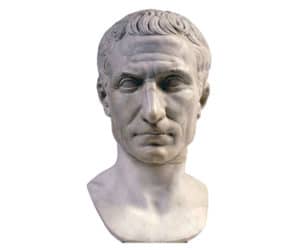
For large image click on picture
Lucius Iunius Brutus
Capitoline Museum,
Rome

The rebellion against Tarquinius failed to achieve final independence for Rome, but it should be the birth of the Roman republic. It was after this revolt, that the senate handed power to two consuls, although at first they were called praetors (a title which later should come to be the name of a different office of the republic). These consuls each held power for one year, in which they ruled much like joint kings of Rome.
What also needs to be kept in mind is that this rebellion was indeed a revolt by the aristocracy of Rome. Rome was never a democracy as we would understand it today, nor as the Greeks understood it. In the early days of the Roman republic all power would reside in the hands of the Roman aristocracy, the so-called patricians ( patricii).

The first ever two elected leaders of Rome were Brutus and Lucius Tarquinius Collatinus. But the people soon turned against Brutus' colleague who was a Tarquin and hence directly related to the despised king. It wasn't long before he left for exile, being replaced by one Publius Valerius Publicola. Soon after a substantial plot was discovered, the aim of which was to place King Tarquin back on his throne. The conspirators were sentenced to death. Among them were Brutus' own two sons.
It is no surprise that after his ridicule, the theft of his inheritence, his brother's murder and the execution of his sons Brutus was filled with hatred toward King Tarquin.
Aided by the city of Veii, King Tarquinius in 509 BC sought to win back his city in battle, but failed. The battle saw the death Brutus, the founder of the Republic. With Brutus dead, it fell to his co-consul Publius Valerius Publicola to lead the Romans to victory. It was therefore he, who was the first ever Roman commander to lead his troops in triumph through Rome.

Lars Porsenna

But king Tarquinius, though defeated, was not yet dead. And so he called upon the help of the fellow Etruscan king of Clusium, Lars Porsenna. Porsenna duly besieged Rome. Legend tells us of the one-eyed hero Horatius Cocles fending off the Etruscan hordes at the Sublician bridge over the Tiber which he asked to be destroyed behind him as he fought.
Other legend tells of Porsenna eventually calling off the siege. A Roman hero, Mucius Scaevola, terrified Porsenna with a demonstration of how determined the Romans were to defeat him, by holding his hand over a naked flame and not removing it until it had burned away.
Consul Publius Valerius Publicola thereafter sought to win over Porsenna arguing it was for him to judge if Tarquin had not been a terrible tyrant whom the Romans were right to depose. Porsenna should decide if Tarquin or the Romans should rule Rome. Tarquin angrily refused the suggestion that Porsenna should be a judge over him. Offended, Porsenna lifted the siege and left. So much to legend.
In reality, the opposite seems to have been the case. Porsenna captured Rome. He didn't place Tarquinius back on the throne, which seems to indicate that he instead planned on ruling the city himself. But Rome, though occupied, must have remained defiant. In an attempt to quell any future revolts Porsenna banned anyone from owning iron weapons.
But this tyranny wasn't to last. Under Roman encouragement other cities in Latium revolted against Etruscan domination. Finally, in 506 BC things came to a head. The allied Latin forces, led by Aristhodemus, met at Aricia with an army which Porsenna had sent against them under the command of his son Arruns.
The Latins won the battle. This was a decisive blow against the Etruscans and now, at last, Rome had won its independence.

War with the Sabines

Consul Publius Valerius was now at the height of his powers. It was at this point people began calling him 'Publicola' ('people's friend'). A war with the Sabines granted him the opportunity to accompany his brother, who had been voted consul after his own term was up, in leading the army to war. The brothers fought a succesful campaign, winning several victories (505 BC). More so, Publicola managed to befriend some of the Sabine nobility. One of their foremost leaders in fact decided to become Roman, bringing with him his entire tribe comprising five thousand warriors. This leader was Attius Clausus. He was granted patrician rank, land beyond the river Anio and adopted the name Appius Claudius Sabinus. He was the original ancestor of the Claudius clan. Publius Valerius Publicola was not finished yet. The Sabines launched another attack and And Publicola was at hand to reorganise the campaign. A crushing blow to the Sabines was finally delivered at their capital Cures by the commander Spurius Cassius (504 BC). The Sabines sued for peace.
Soon later Publicola died. The people of Rome granted him a state funeral within the city walls.

War with the Latin League

Rome was evidently the largest city within Latium. And the confidence it gained from this knowledge made it lay claim to speak on behalf of Latium itself. And so in its treaty with Carthage (510 BC) the Roman republic claimed control over considerable parts of the countryside around it.
Though such claims the Latin League (the alliance of Latin cities) would not recognize. And so a war arose about the very matter. Rome, having won independence from the Etruscans already faced its next crisis. The very Latin force which had defeated the Porsenna's army at Aricia now was used against Rome.

On the other hand, the man leading the Latin league against the Romans was Octavius Mamilius, the son-in-law of King Tarquin.
There may therefore have been other reasons than merely the question of supremacy within the league. In 496 BC the Roman forces met those of the Latin League at Lake Regillus. (Legend has it that the divine twins Castor and Pollux, the Gemini, appeared to senator Domitius before this battle, foretelling the Roman victory.)
Very tellingly King Tarquin was present at the battle, fighting the side of the Latin League.
The leader of the Latins, Octavius Mamilius, was killed in battle. King Tarquin was wounded. Rome claimed victory. But if this was really so, is unclear. The battle may well have been an indecisive draw. In either case, Rome's ability to withstand the combined might of Latium, which had earlier defeated the Etruscans, must have been an astonishing fete of military prowess.
In about 493 BC a treaty between Rome and the Latin League was signed (the foedus Cassianum). This might have been due to the Latin League admitting to Roman superiority on the battle field at Lake Regillus. But more likely it was because the Latins sought a powerful ally against the Italian hill tribes who were harassing them. Either way, the war with the Latin League was over. The Roman republic now firmly established, King Tarquin retired to exile in Tusculum, not to be heard of again.

The Early Conflict of the Orders

The revolt against King Tarquin and Porsenna was led entirely by the Roman nobility, so it was essentially only the Roman aristocrats (the patricii) who held any power. All decisions of note were taken in their assembly, the senate. Real power rested perhaps with little more or less than fifty men. Within the nobility of Rome itself power centred around a few select families. For large part of the fifth century BC names such as Aemilius, Claudius, Cornelius and Fabius would dominate politics.
There was indeed an assembly for the people, the comitia centuriata, but its decisions all needed the approval of the patrician nobles.
The economic situation of early Rome was dire. Many poor peasant fell into ruin and was taken into slavery for non-payment of debt by the privileged classes.
Against such a background of hardship and helplessness at the hands of the nobles, the commoners (called the 'plebeians ' (plebeii) organized themselves against the patricians. And so arose what is traditionally called 'the Conflict of the Orders'.
One believes that the plebeians were partly inspired by Greek merchants, who most likely had brought with them tales of the overthrow of the aristocracy in some Greek cities and the creation of Greek democracy.
If inspiration came from Greek traders within Rome's walls, then the power the plebeians possessed stemmed from Rome's need for soldiers. The patricians alone could not fight all the wars which Rome was almost constantly involved in. This power was indeed demonstrated in the 'First Secession', when the plebeians withdrew to a hill three miles north east of Rome, the Mons Sacer (or possibly to the Aventine).
Several such secessions are recorded (five in total, between 494 and 287 BC, although each one is disputed).
Leadership of the plebeians was largely provided by those among them, perhaps wealthy landowners with no noble blood, who served as tribunes in the military. Accustomed to leading the men in war, they now did the same in politics.
It was most likely after the First Secession in 494 BC that the patricians recognized the plebeians rights to hold meetings and to elect their officers, the 'tribunes of the people' (tribuni plebis). Such 'tribunes of the people' were to represent the grievances of ordinary people to the consuls and the senate. But apart from such a diplomatic role, he also possessed extraordinary powers. He possessed the power of veto over any new law the consuls wanted to introduce. His duty was to be on call day and night to any citizen who required his help.

The fact that plebeian demands didn't seem to go further than adequate protection from the excesses of patrician power, seems to suggest that the people were largely satisfied with the leadership which the nobility provided. And it should be reasonable to suppose that, despite the differences voiced in the 'Conflict of the Orders', Rome's patricians and plebeians stood united when facing any outside influence.

Coriolanus and the War with the Volscians

Caius Marcius Coriolanus is a figure of whom we are today not sure if he ever existed. He may indeed be a myth, yet one can never be certain. The story goes that Coriolanus was defeated in his bid to get elected consul. This was largely so because he had vehemently opposed the creation of the office of Tribune of the People after the 'Conflict of the Orders'. Coriolanus, however, was a man to bear grudges. When during a famine grain was shipped from Sicily, he proposed that it only be distributed to the plebeians once they had forfeited their right of representation by the Tribunes.
The suggestion outraged Rome. His fellow senators would not agree to starve their own people for political gain.
Instead the grain was distributed without condition and Coriolanus was charged with treason by the Tribunes. It was his record as a war hero in the war with the Volscians which saved Coriolanus from death, though he was exiled from Rome (491 BC).
Coriolanus' skills as a military commander now attracted the attention of his old enemy, the Volscians. Their leader Attius Tullius now offered him command of their forces.
The talented Coriolanus soon defeated the Roman army, driving them before him, until he and his Volscian army besieged Rome itself. The Romans sent delegations, including his wife and mother to beseeching him to lift the siege.
Finally, Coriolanus did retire his army, though it is unclear why. Possibly, the Romans ceded them control of cities they had conquered from them, yet this is little more than guesswork.
Coriolanus never returned again. But the war with the Volscians was to was to continue on and off for decades.

Rome as a regional Power

Rome had rid herself of Etruscan despots and achieved supremacy within the Latin League. Now she stood at the head of Latium. But enemies still loomed all around; the Etruscans were still a potent force and hill tribes such as the Volscians and Aequians threatened the plain of Latium.
Rome was therefore always at war, attacked or attacking her Etruscan neighbour Veii, or the Volscians or Aequians, or an occasional Latin foe.
Meanwhile the Hernicians (Hernici), who were a Latin tribe wedged between the Aequians and the Volscians, were won over as allies by Rome (486 BC). It was a typical example of the Roman motto 'divide and conquer'.

When the Etruscan sea power was shattered by Hieron of Syracuse at Cumae in 474 BC, the menace from Etruria was so much weakened that for nearly forty years there was no war with Veii.

Capitolinus and Unrest in Rome

Back in Rome itself the Conflict of the Orders remained an ongoing problem. In 471 BC the consulship was shared between Appius Claudius (we are not sure if this was in fact the original Attus Clausus, or his son) and the impressive Titus Quinctius Capitolinus Barbatus. The former carried on in much the same vein as Coriolanus and many proud and arrogant patricians, whereas the latter tried to steady the ship of state at a tumultuous time. When Claudius was provoking the crowds in the forum with an arrogant speech, it fell to his consular colleague Capitolinus to order him removed from the forum by force before a riot ensued. Capitolinus was widely trusted and respected. This popularity showed at the ballot box. He was already re-elected consul by 468 BC. Rome desperately needed the steady, calm nerve of Capitolinus. The war with the Volscians and Aequians continued and Rome was in ferment. The city was growing at a startling rate. The men of voting age now numbered no fewer than 104,000. These were volatile, unpredictable times.

One day a wild rumour circulated that a Volscian army had evaded the legions and was marching on the undefended capital. Panic gripped the city. Once more it was Capitolinus who calmed the people, urging them to wait until it could be confirmed if the story were true or not. It wasn’t.

In 460 BC such was the chaos in the city that a Sabine called Herdonius, leading a party of slaves and exiles captured and occupied the Capitol. Consul Valerius lost his life retaking the Rome’s most prestigious hill. His replacement was one Lucius Quinctius Cincinnatus, whose name should come to be the embodiment of republican virtues to all Romans (and not merely to Romans, as the US city of Cincinnati illustrates). Cincinnatus was a patrician and opposed to greater rights for the plebs. He used his consular office to block legislation put forward by the tribunes of the people in favour of the plebeians. However, for the next year his political opponents proposed the very same tribunes as candidates for office to see the legislation forced through regardless. The senate, outraged at such selfish behaviour immediately nominated Cincinnatus to take the office of consul again, in order to maintain the stalemate. Cincinnatus refused the honour. He made it quite clear that he had no intention of breaking the rules of office and standing in successive years, albeit that his opponents were cheating. May they be disgraced, but no he. All Rome was impressed.

When an army under the command of Furius became trapped in Aequian territory Capitolinus, no sooner had the news reached him, gathered up what soldiers he could, called upon the allied Hernicians for support and marched on the Aequians and drove them off, allowing Furius and his men to withdraw safely.

Cincinnatus

If Rome was straining in her war with the Aequians and Volscians, the situation became yet more serious when the fierce tribe of the Sabines now also joined the fray. With one consular army fully deployed, the other, under the command of consul Lucius Minucius, advanced to attack the Sabine enemy garrison on Mt Algidus and found itself cut off and besieged. The situation was dire and the Romans elected to appoint a dictator. This man, freed from the usual restraints of office, should tackle the crisis. To grant such limitless powers was of course a great risk. The appointment of a dictator always begged the question if the chosen man would readily hand back power when his task was fulfilled. The choice fell upon Cincinnatus. No doubt all Rome still remembered him as the man who rejected the opportunity of being made consul for a successive year. The delegation of senators sent to bring him the message needed to travel to his farm. The story goes that Cincinnatus had fallen on hard times. Paying the bail for his son Caeso who, accused of murder, had fled into exile, had cost Cincinnatus his entire fortune. He’d retired to a small holding outside Rome and living as a humble peasant farmer.

Now, one suspects that there was an element of political theatre involved here. Cincinnatus was from an extremely rich family which owned vast swathes of land. Nevertheless the delegation found him ploughing his fields (or digging a ditch) when they brought him the news of his election to the office of dictator. What followed was remarkable. Cincinnatus left his farm, levied an army in Rome, marched on the Sabines defeat them in battle and enabled Minucius’ army to retreat safely. On his return Cincinnatus celebrated a triumph and resigned his powers. He had been dictator, - the supreme commander of Rome, - for only 15 days. Only one extravagance had he allowed himself. He saw to it that the witness who had testified against his son Caeso was expelled from Rome. He otherwise did not abuse his power in any way, did not seek to extend it for a day longer than necessary. He merely did his duty and then returned to his farm. In 439 BC Capitolinus was elected consul for sixth time. He and his colleague, Menenius Agrippa, soon learned of a plot led by Spurius Maelius to seize power. At once they proposed that Cincinnatus be made dictator for a second time to prevent this outrage. Cincinnatus, by now in his eighties, soon dealt with the matter and Maelius came to a bloody end. Once more he resigned his commission immediately. Within his lifetime Cincinnatus became a legend to the Romans. Twice granted supreme power, he held onto it not for a day longer than absolutely necessary. The high esteem in which Cincinnatus was held by his compatriots is best illustrated with an anecdote towards the very end of his life. One of Cincinnatus’ sons was tried for military incompetence. He was defended by none other than the great Capitolinus, who simply asked, if the accused was convicted, who would go to tell the aged Cincinnatus the news. The son was acquitted. The jury couldn’t bring itself to break the old man’s heart.

The Decemviri

One demand voiced by the plebeians as part of the Conflict of the Orders was that of written law. For as long as there was no simply code of written rules, the plebeians remained virtually at the mercy of the patrician consuls who decided what the law was.
So three eminent Romans were sent to Athens in 454BC to study the code of laws created by the great Solon. The fact that they were sent to Athens once again suggests there being a strong Greek influence upon the demands made by the plebeians. In 451 BC the delegation returned.
Their proposal was that for one year not two consuls but a group of ten men should run the affairs of state and prepare the new code of laws. In practice this meant they would act as supreme judges and their collected judgments would be used to build the code of laws over the twelve months they were in office.
So in 451 BC a commission was set up. It consisted of ten patricians. They were called the decemviri ('the ten men') and were charged with creating a simple code of laws within a year. The man who should emerge as their leader was Appius Claudius Inregellensis Sabinus Crassus. If his full name seems a bit of a mouthful it is no great surprise that today he is generally referred to as Appius Claudius ‘the Decemvir’.
He was possibly the son or the grandson of the first Appius Claudius who came to Rome from the Sabines. The two great men of Rome, Capitolinus and Cincinnatus, were excluded from the decemviri, most likely due to their involvement with the expulsion of the witness in the trial of Cincinnatus’ son Caeso.
After the year had passed, the decemviri had produced ten tables, listing the laws which should govern Rome.
The plebeians were delighted. But it was judged by all that the work was unfinished and so another ten men should be appointed, this time consisting of five patricians and five plebeians, to complete the work.
The immense popularity of the Tables meant that now political heavyweights were keen to become decemviri. Capitolinus and Cincinnatus were now also running.
Appius Claudius was the only of the previous decemvir to seek re-election. This was frowned upon as an ominous thirst for power, contrary to the traditions of the republic. Capitolinus and Cincinnatus instead proposed for him to preside over the election. If they assumed this would stop him from standing as a candidate they were wrong.
Appius Claudius manipulated the rules so that the only major candidate in the election was he himself. This was a frightful sign of what was to come. No sooner were the ten new decemviri elected, then Rome awoke to a tyranny.
During the time in which the decemviri were in office the Roman constitution was no longer in place, for they ruled in place of the consuls. The first year had seen the ten dutifully performing their office as intended. However, the second year saw blatant injustice and their judgments being made in favour of friends and cronies. The rich and powerful could leave for their villas in the countryside and wait for the inevitable end to come. But the plebeians had no means of escaping the tyranny.
The work to codify the laws of Rome was completed. The year passed. Yet the decemviri did not stand down.
Some patricians such as the Horatii and Valerii, tried their best to oppose the tyrants, yet with little success.
But with the plebeians being tyrannized, the army quickly was virtually refusing to fight. Meanwhile the Aequians and Sabines were pressing hard. Disaster was looming.
Finally, Appius Claudius ‘the Decemvir’ utterly over-reached himself. Smitten with a girl called Verginia who was engaged to another man, he fabricated a story by which a Marcus Claudius claimed she was his slave. Appius Claudius presided over the trial himself and of course proclaimed Verginia was indeed the slave of Marcus Claudius. No doubt this meant her betrothal was invalid – and he therefore would be able to make his own move on Verginia.
Entire Rome was outraged. The girl’s father, a centurion called Verginius, killed her on hearing the verdict rather than allowing her to be enslaved. The deed done he then fought his way out of the city. It appears a large part of the city’s plebeians joined him. They took to the Janiculum Hill on the far side of the Tiber and refused to return unless the decemviri resigned. So began the Second Secession (449 BC).
With the Aequians and Sabines bearing down on Rome the surrender of the decemviri was inevitable. Rome needed her army and for this she urgently needed the plebeians. The decemviri resigned on one single condition; that they not be turned over to the plebeians who would have torn them to pieces. If the other nine escaped punishment, the despised Appius Claudius now got his just desserts. Verginius accused him of breaching one of the very laws laid down in the Twelve Tables; that no-one should be permitted to falsely enslave a free person. He was thrown into prison where he took his own life.
Although it is also possible that the Tribunes of the People killed him.

It is worth mentioning that, apart from the above version of the tale, some historians believe that the same ten patrician devemviri ruled for two years, preparing the Twelve Tables. But when the plebeians deemed the laws not far-reaching enough, they forced them to resign and instead brought about the appointment of two more radically-minded consuls. In that case the tale of the outrages of Appius Claudius would be mere fabrication.

In any event the creation of the Twelve Tables was a milestone in Roman history. Rome henceforth should be a society ruled by law rather than by men.

The Twelve Tables

So came about the famous written Roman law, the Twelve Tables. The laws were engraved in copper and permanently displayed to public view. The twelve copper tables were a simple set of rules governing the public, private and political behaviour of every Roman.

The Twelve Tables
The Twelve Tables

War with Etruria, the Volscians, Aequians and Falerians

The power of the Aequian, Sabine and Volscian hill tribes was eventually – and inevitably - broken. The Aequians were defeated on their stronghold on Mt Algidus in 431 BC. In all wars of the fifth century BC the balance of victory lay with Rome and her allies.
Usually this involved a gain of territory by the victors, the lion's share going to Rome whose strength therefore constantly increased.

By the end of the fifth century BC Rome had in fact become all but the mistress of Latium. The Latin cities, known as the Latin League, might have still been independent, but they were increasingly subject to Roman power and influence.
A final war with the Etruscans of Veii led to the great city’s fall in 396 BC when Marcus Furius Camillus and his second-in-command Cornelius Scipio besieged it and successfully undermined the walls. Veii was so important and beautiful a city, it’s conquest was a substantial victory for Rome and marks a significant step in her ascent to power. Famously, the great statue of Juno, queen of the gods, was taken from Veii, moved to Rome and placed in a temple specially built for her.
The decisive victory over Veii, which added a great area on the west of the Tiber to Roman territory, was in part due to pressure on Etruria by a new enemy, the Gauls, who by this time had completely overrun the basin of the Po and from there were crossing the Apennines into Etruria itself.
The Etruscans had also been driven out of their possessions in Campania, south-east of Latium, by the Samnites, descending from the hills.

Rome virtually remained at a constant state of war. In 394 BC it was the turn of the Falerii. When Camillus arrived to lay siege, a teacher kidnapped several noble children in his charge and delivered them to the Romans, promising that with these hostages in Roman hands, the Falerians were bound to surrender.
Camillus would have none of it. He freed the children and returned them to the Falerii, with the treacherous teacher as their captive. The result was startling. So struck were the Falerians by the honourable act of their enemy, they surrendered to him at once.

The surrender of the Falerii proved bad news for Camillus, for his army had hoped for plunder. The division of the spoils from Veii had already disappointed many, now the failure to win any loot from a foe that turned friend erupted in anger. His celebrations in Rome when on his triumph having his chariot pulled by four white horses (deemed sacrilegious at the time) also had done little for his popularity.
As was so often the case in the history of the republic, it ended in the courts. Camillus was charged with stealing loot (from Veii) that belonged to the state.
He was sent into exile. Legend has it that Camillus in outrage at such injustice and ingratitude prayed to the gods to make it so that Rome should be in need of his return.

Invasion by the Gauls

Camillus soon got his wish. The Gauls were coming. The invasion by the Gauls from the north may have weakened Etruria so much that Rome had at last succeeded in conquering its old enemy Veii, but it wasn’t long before the flood of Celtic barbarians should be heading for Rome itself. There was no stopping this ferocious barbarian onslaught.
The Gauls rolled through Etruria and headed towards Rome. In 386 BC they met the Roman army at Allia (11 miles outside Rome). The Roman allies broke and fled. The legionaries were outflanked and crushed. It was a massive defeat.
Legends afterwards tell us of the invasion of the city. Barbarians are said to have broken into the senate house and been awestricken by the dignity of the silent, seated senators, before massacring them all. The attempt of a surprise attack on the besieged Capitol was frustrated by the cackling of sacred geese of Juno which warned the Roman guards.
Rome’s desperate plight called for the exiled Camillus. Appointed dictator, he raced to gather what forces he could. Shattered Roman contingents were drawn together and allies summoned. As Rome bled the man she had so ungratefully thrown out was now was her only hope for rescue.
Romans and Gauls, after months of occupation, sought to reach a settlement. The Gauls (from the powerful tribe of the Senones) were falling prey to disease and had also received news that their own territory was invaded by the Veneti in their absence. Food was also in short supply and any sorties into the countryside to loot foodstuffs were met by Camillus and his forces. A famine was threatening. No doubt the Gauls were keen to turn home, though no more than the Romans wished them to leave. So it was agreed that a ransom was to be paid. The sum was colossal: one thousand pounds of gold.
Legend gave us the famous scene of the huge ransom being weighed out on scales fixed by the Gauls. When Quintus Sulpicius complained at such cheating, the Gallic chief Brennus added his sword to the counterweight with the words 'Vae victis' ('Woe to the vanquished').
Before the ransom was ever paid, Camillus and his army arrived. Brennus was told by his new adversary that Rome would pay not in gold, but in steel.

This story of Camillus and his ramshackle forces defeating the Gallic horde has a hint of propaganda about it, invented to disguise a defeat and – worse - Rome being at the mercy of barbarians and needing to buy her freedom. Yet we cannot discount entirely that the story may be true. The recurring theme of Roman history is the strength of her resources. When defeated she always regrouped and fought back again and again. Also, there may have been allies willing to support Camillus, if only to prevent the Gallic rampage from heading their way from Rome.
So the tale of Camillus' victory over the Gauls may possibly be true.
The definite fact which survives is that the Gauls, having swept devastatingly over Etruria, poured into Rome, sacked it, and then rolled back to the north.

Etruria never recovered from the blow, whilst Rome reeled under it.

Rome rebuilt

The city of Rome had been ravaged by war. The Gauls may have not been able to take the Capitol, yes, much of the remaining city had been laid waste.
So badly mauled had the city been by the barbarian sacking, it was even considered to abandon Rome and to move the population to the beautiful city of Veii instead. Of course this never happened. Instead building materials were provided at public expense, that every citizen should rebuild his home, as long as he gave an undertaking to do so within the year.
It was often said that Rome’s ramshackle layout and its chaotic city streets were direct result of this rushed reconstruction. So too it appears that the Romans, as part of this rebuild, now finally decided on a proper city wall.
What is called the Servian Wall, as Romans attributed it to King Servius Tullius (who much more likely only built the agger earthworks on the Quirinal, Viminal and Esquiline Hills), is generally believed to have been built after the retreat by the Gauls.
The wall spanned five miles in circumference with nineteen gates, embracing all seven hills of Rome. This new impenetrability only further re-enforced roman claims to dominance over the wider region. Hence she could wage war in the region with no fear for her own safety, as the tribes had not the means of breaching such defences.

The Later Conflict of the Orders

The Gauls having withdrawn and Rome being the confirmed leader of Latium, the old struggle between the patricians and the plebeians renewed in intensity again.
Naturally, it had in effect never gone away but had continued on as a process which now came to a head.
The small plebeian landowners ached under the strain of military service and the terrible losses they had suffered during the invasion of the Gauls.
They looked with resentment upon the patricians who still commanded the consulship and so had access to decisions regarding what should happen to conquered land. Land no doubt many plebeians hoped for receiving a share of to alleviate their hardships.
One major effect the wars had had on Roman society was to reduce the number of patricians significantly. Having a share of the army beyond their proportion of the populace, the patricians had had to suffer terrible losses during the wars.
Apart from this, several patrician families saw political advantages in championing the cause of the plebeians, so gaining vast popularity, but serving to further undermine the status of the patrician class. Largely these will have been the families of those who had intermarried between the classes, ever since it had been allowed in 445 BC.
Aside from this, the wealthier plebeians now had their eyes on power, seeking to hold office themselves rather than merely attending the senate.
With the patricians weakened and the aspirations of the plebeians on the rise, the erosion of the constitutional differences between the two classes was inevitable.

The 'Licinian Rogations'

It fell to two tribunes of the people, Caius Licinius Stolo and Lucius Sextius to propose a great reform bill. The bill dealt with matters of debt and land reform, but most significantly it proposed admission of plebeians to the office of consul. Naturally, the patricians rejected the proposal out of hand, for it seemed to undermine their wealth, their land holdings and their privileges of office in equal measure. But Licinius and Sextius were made of stern stuff. They now followed a policy of vetoing any election, making state business impossible. This period in Roman history is at times referred to as ‘the anarchy’, as Rome possessed no government to speak of. The only elections which the two permitted were those for the tribunes of the people. The people again and again saw to it that Licinius and Sextius were re-elected and could continue to block any government matters, until the patricians gave way.

The patricians put up a brave struggle to defend their privileges. But the writing was on the wall. In fact it was the very hero of the patrician faction, Camillus, who in his final dictatorship, granted him to fight off the second invasion of the Gauls, forced the senate to accept the 'Licinian Rogations' (367 BC). With a stroke, the consuls were now to be one patrician and one plebeian. The principle was now established that plebeians could indeed rule. The deadlock was broken.
The rich and powerful soon found ways around those parts of the Licinian Rogations which dealt with debt and land distribution.
But the requirement that one of the consuls must be a plebeian was the death-blow to the privileges of the old aristocracy.
The Conflict of the Orders should last for several decades thereafter, but the winners were inevitably going to be the plebeians. If the patrician struggle for their exclusive right to various offices continued, the law of 367 BC was the beginning of the end. In 356 BC Rome saw the first plebeian dictator take office. By 351 BC the first plebeian took the office of censor. By 342 BC both consuls could be plebeian. By 300 the praetorship was open to plebeians.

Rome rising power within Italy

In 367 BC the Gauls came south anew, but Camillus now had the measure of them. They were unceremoniously defeated and driven back north. That same year, 367 BC, the great tyrant Dionysius of Syracuse died, leaving to his son an empire which at that moment seemed destined to dominate Italy, a more mighty power than the expanding republic on the Tiber. Syracuse stood supreme as the most powerful Greek city state. Yet it soon crumbled, having been held together largely by Dionysius’ personal genius, rather than being a coherent empire. So, as Syracuse waned its dominions in southern Italy represented tempting prizes to whomsoever could muster the strength to conquer them.
Of course the lack of a strong, well established imperial power on Italian soil proved of immense benefit to the expansion of the Roman state. Though initially it only benefited the wild Italian hill tribes who now began to harass the rich Greek merchant cities of the Magna Graecia (southern Italy).

Rome may have been a significant power in Italy, but the area of her supremacy was still limited to Latium and a portion of Etruria.
Now she was to be faced with a new and formidable foe, the Samnite confederacy.
A major part in Rome’s continual ascent was played by the series of Samnite wars beginning in 363 BC and ending in 290 BC.
But even before the struggle with the Samnites opened, Rome’s ascendancy after the Gallic invasion was seriously threatened. It was perhaps only because the neighbours who feared her dreaded still more the Gallic menace from which they had already suffered so severely, that Rome was able to do more than merely hold her own. There were, moreover, Latin cities which even allied with the Gauls against her, thereby forcing the rest of the Latins, however reluctantly, to throw themselves under the protection of Rome. The Latin League was renewed on terms more definitely emphasizing the superior status of Rome (358 BC), and the third Gallic tide was rolled back in 358 BC (or possibly 360BC). But not without Rome heaving to retire behind her new walls and await the Gallic retreat.
Etruscan cities seized the opportunity to attack Rome in the hour of her embarrassment. She suffered some defeats, but by 351 BC the Etruscans were forced to accept a peace for forty years.
After this Gallic invasion the Romans decided it wise to set up an emergency fund (the aerarium sanctius) that was to be used in the event of another invasion. This special reserve was kept in the state treasury at the temple of Saturn at the Roman Forum.

In that year and the next the Gauls renewed hostilities yet again, only to be driven off by the son of the great Camillus who had beaten them forty years before.
The Latins were held well in hand, and Etruria was bound to peace for many years to come. Rome now stood virtually unchallenged in her immediate region. At this stage, Carthage recognized Rome as the coming great power, and agreed with her the momentous treaty of 348 BC - in the view of some authorities, the first between the two states, while others regard it as a simple renewal of a treaty supposedly made in 509 BC, the very first year of the republic.
If the Gallic menace persisted it was diminishing. By 331 BC the fierce Gallic tribe of the Senones finally sued for peace.

Roman Treaty with Carthage

In the treaty of 348 BC Carthage undertook to respect all Latin territory and coast towns as a Roman sphere of influence.
Carthage was barred from possession of territory, but not from action.
In particular, if the Carthaginians should sack a town in Latium which was not under Roman protection, captives and loot may be taken away, though the site was thereafter to become a Roman possession. The treaty seems to have made a significant distinction between areas under direct Roman protection and cities who were mere allies of Rome. Cities under Roman rule were to be immune from Carthaginian attack altogether, whereas allies were not.
Roman traders and merchants were granted admission to the ports of Africa, Sardinia and Sicily, as well as to Carthage itself.
Roman ships of war were to enjoy access to these ports in wars against third parties.
Carthaginian merchants were granted access to Rome.
The Romans in turn were excluded from settling in Sardinia and Africa and accepted limits on Roman seafaring. Importantly, Carthage was granted freedom of military action in Italy.
It seems to have been a major Carthaginian concern to prevent Rome interfering in any of its attacks on Greek cities in the south. Evidently Carthage was aware of Rome’s growing military prowess.

First Samnite War

Five years after the conclusion of the treaty with Carthage, Rome was at war with the Samnites. For centuries the hill tribes of the Appennines had sought to conquer the plains below. In Latium such tribes as the Aequians, Volsquians and Sabines had come up against the Romans.
Yet further south, in the Campania the Samnite confederacy was now surging into the plain of Campania. The Samnites had a reputation as fearsome, only half-civilised mountain warriors. Ironically the vanquished Campanians largely proved to be descendants of previous Samnite invaders who had settled down to less warlike living.
Rome had wisely chosen to ally with the Samnites. It may in fact have been the case that some previous campaigns against the Gauls had seen Samnite allies fighting alongside Roman legionaries.
Yet now a great price beckoned that would divide them. Capua, one of the richest cities of Italy.
As the hill tribes in the south of Italy were battering Greek cities no longer protected by the great naval power of Syracuse, these appealed to Greece for help.
However, Capua and the Campanians turned to Rome. The city itself has seen its army defeated and driven behind its walls, with the Samnites not camped out on Mount Tifata just outside the city.
Rome renounced her treaty with the Samnites and marched her armies south to Campania. The Roman hero Marcus Valerius Corvus headed one consular army. He defeated the Samnites at Mount Gaurus and again at Suessula. The other army, commanded by Cornelius, was first trapped in the Samnite valleys. But once extracated by the intervention of a third Roman force commanded by Publius Decius Mus, Cornelius went on to add yet another decisive victory to the Roman campaign.
The Samnites were roundly defeated and driven out of the plain of Campania.
The victory was impressive. Italian hill tribes were usually not that easily dealt with. In two years, 343 and 342 BC, Rome had extended her sphere of influence with consummate ease. So striking was this success that Carthage sent an embassy to congratulate Rome on her triumph.

Mutiny of the Army

Yet Rome was not to have it all her way. Far from it. In 342 BC she was struck by the mutiny of some of her own troops in Campania. Rome had never stationed garrisons such a distance from the city itself and the men proved unwilling to protect Capuans from Samnites indefinitely. Yet there were also problems within the structure of the army itself as some of the privileged abused their positions to bestow favours and the equestrian horsemen were paid three times the rate of ordinary infantry. If the mutiny started in Campania it soon spread and a rebellious army was eventually camped only eight miles from Rome. Meanwhile there was the war with the Samnites to consider. It was clear one could not continue a war with a mutinous army camped outside one’s own gates.

Somehow at the moment of victory against the Samnites, where foreign powers acknowledged Rome’s prowess, the Roman mutiny had managed to turn a triumph into an utter fiasco.

Marcus Valerius Corvus was appointed dictator to deal with this debacle. Rather than seek a fight he chose to negotiate a settlement and address the concerns of the soldiery. Rules were introduced to discourage abuse of privilege and promises were made to address matters of unfair pay. Also Valerius had the wisdom not to seek punishment of any ringleaders. He had realized that initial promises of negotiation that disguised a desire to separate, arrest and punish the leaders of the mutiny had only further inflamed feelings among the ranks.

Rome’s temporary weakness forced her to settle the war with the Samnites who luckily were also being challenged on another frontier at the time and hence sued for peace (341 BC). The treaty provided not only for peace between the two sides, but renewed their old alliance.

The Great Latin War

Yet a much greater crisis loomed as a consequence of the Roman mutiny.

When the mutiny forced Rome to make peace with the Samnites, the Campanians, depending on their ally, found themselves suddenly abandoned. More so, the Latins who had been forced into a war with the Samnites they had never asked for, suddenly felt themselves still at war with the fierce hill tribe, while the Romans who had dragged them into it had bailed out and come to terms.
Worse, Rome was now allied with the Samnite enemy!
It was therefore perfectly understandable that the Latins and the Campanians felt betrayed. They now formed an alliance of their own, which the Volscians also joined).
Further, the Latins demanded of Rome that the treaty of the Latin League be re-negotiated allowing the Latins equal say in matters, that they never be drawn into a war against their own will again.
This may indeed have been a challenge to Roman dominance but, given the recent fiasco, it sounded perfectly justifiable. Had it remained at that Rome may well have come to terms with her neighbours. Fatally, the Latins went further. They demanded that the Roman constitution be amended, whereby one of the consuls and a significant proportion of seats in the Roman senate be set aside for Latins.
This Rome could never accept. The Latins had been foolish enough to provide the Romans with a cause for war.
Marcus Valerius Corvus had very quickly succeeded in quashing the mutiny, mainly by reconciliation. His forces were ready the moment war was declared (340 BC). While the Latins were still gathering their forces, Valerius marched his troops south, united with an army of Samnite allies and then, at Suessa Aurunca, descended upon a Latin-Campanian army which was utterly defeated.
Rome now offered the Campanians a favourable peace. Of course they accepted. It was a classic example of the motto: ‘divide and conquer.’
This left the Latins to face the Roman-Samnite war machine with only the Volscians as allies. The outcome was inevitable. In two years of campaigning Rome thoroughly defeated the Latins and conquered the city of Antium.
For large image click on picture
Latin warrior of the 4th century BC
Museo della Civilta,
Rome
The effect of the 'Great Latin War' was to tighten Rome's grip upon Latium and to provide her with more lands upon which to settle her ever-increasing agricultural population. The Latin League was finally dissolved (338 BC). Some of the cities were granted full Roman rights, others were admitted to civil but not to political rights of Roman citizenship. All were debarred from forming separate alliances with each other or any external power.
Rome no longer dominated a Latin alliance. Rome now ruled Latium.

Alexander 'the Molossian'

The south of Italy with its Greek colonies had fallen under Syracusan dominance during the reign of Dionysius. However, with his death in 367 BC and the subsequent demise of Syracusan power, this area, known as Magna Graecia, had become disputed territory.
If Dionysius had used the fierce Italian hill tribes against the Greek cities in order to bring them under his sway, then now these same hill tribes formed the Bruttian League and set out to conquer these dominions for themselves.
In 343 BC the city of Tarentum finally appealed for help to the mighty city state of Sparta.
In response, the Spartan King Archidamus headed an expedition. Yet it failed disastrously and the king was killed in battle with the Lucanians in 338 BC.
Next in 334 BC, when Alexander the Great was starting on the great eastern venture, his uncle Alexander 'the Molossian' of Epirus answered the call of the Tarentines, very likely with imperial dreams of his own.
Alexander of Epirus proved himself an able general and Rome soon saw it wise to form a treaty with him promising not to intervene in favour of the Samnites (334BC). Given that the Samnites were allies of Rome at the time this was a clear breach of faith.
Yet Rome was most likely concerned about the strength and quality of Greek military power being deployed and hence sought to remain neutral.
The Molossian’s success was rapid, as he defeated the Samnites and Lucanians in battle and conquered town after town.
So startling were these successes, Tarentum now grew worried about the ambitions of the man whose help she had sought.
Yet Alexander’s career was to be cut short. In 330 BC a Lucanian assassin stabbed him before he could consolidate his power in Italy. He left no successor to carry on his project in Magna Graecia.

The Second Samnite War

The period between the Great Latin War and the Second Samnite War saw the two main military powers jostling for position on the Italian mainland. The Romans gradually increased their influence in Campania, founding colonies in strategic places, helping to secure Capua against any threat from the Samnites. Meanwhile the Samnite confederacy continued to make war upon Tarentum to the south.
So far, the supposed allies could continue their uneasy peace.
But when in 334 BC the Romans agreed a treaty with Alexander ‘the Molossian’ not to aid the Samnites any illusions of their being allies were dispelled.
For several years the anxious piece held. Finally, in 327 BC a local dispute in the city of Neapolis saw the Samnites establish a garrison there. Capua inevitably complained to Rome. The Romans sought to negotiate with the Samnites but were rebuffed.
What had seemed inevitable all along had now come to pass. The two chief military powers were going to fight it out for predominance on the Italian peninsula.
The Romans laid siege to Neapolis and the Second Samnite War began (326 BC).

This war posed a new challenge altogether to the Romans. Had the first war against the Samnites proven that the legions could deal with the hill men in the plains of Campania yet taking them on in their mountain strongholds was an entirely different matter.
So at first a stalemate ensued, whereby the Samnites could not venture into the plains, yet the Romans could not ascend into the mountains.
In 325 BC Rome began to venture further afield, for the first time having an army cross to the Adriatic coast. Minor victories were won and valuable allies gained.
The war moved slowly, yet the initiative seemed to lie with the Romans.
Then in 321 BC disaster struck.

As Rome attempted a frontal assault on the Samnite heartland an army of 20,000 Romans and allies, led by the republic’s two consuls, was trapped by the Samnite general Caius Pontius in a mountain pass between Capua and Beneventum known as the Caudine Forks, where it could neither advance nor retreat. The Roman army faced certain annihilation and was forced to surrender.
The terms imposed were one of the gravest humiliations Rome suffered in all her history. One had lost without a fight.
The troops were disarmed and compelled to undergo an ancient ritual of subjugation. Man by man, as a foe vanquished and disgraced, they were made to pass ‘under the yoke’. In this case it was a yoke made from Roman spears, as it was understood to be a greate indignity to the Roman soldier to lose his spear.
Meanwhile the captive consuls agreed to a peace treaty by which Rome would surrender several of her Campanian towns and hand over no less than six hundred equestrians as hostages.
The army returned home in disgrace. The consuls resigned. Rome was humiliated.

The senate refused to accept the treaty. It argued that the two consuls had not possessed the authority to accept such conditions without prior sanction by the senate of Rome. (Technically, power over declarations of war and peace lay with the comitia centuriata and foreign policy with the senate.)
Of course this was pure semantics. Rome would use any excuse to allow her to fight on and expunge the humiliation she had just suffered.
Cruelly the two consuls were delivered to the Samnites as that the enemy may do to them as they wished, as punishment for their agreeing to a treaty without proper authorization. The only to emerge from this affair with honour was Caius Pontius. For when the Samnite general was presented with the two Romans he simply rejected any idea of punishing them and sent them back to Rome as free men. Pontius knew that his rejection of savagery added only further to Rome’s shame.

The war now returned to the slow pace it had taken prior to the rash attack that had led to the Caudine catastrophe.
At first the Samnites held the upper hand. Rome was forced out of some strongholds and in 315 BC Roman strategy to push onward toward the Adriatic suffered a crushing blow at the Battle of Lautulae.
Rome reeled. Campania was on the verge of deserting. Capua briefly even switched sides and allied with the Samnites.
But Rome, as was her strength through out the ages, redoubled her efforts. Her infantry levy was increased from two to four legions.
The war began to turn in Rome’s favour. In 314 BC the Samnite stronghold of Luceria was conquered and made a Roman colony. Importantly, the 600 equestrians held as hostages ever since the Caudine Forks were freed with the conquest of Luceria.
The Samnite confederacy found itself invariably pushed back on every front.
Capua hastily surrendered and became a Roman ally yet again (314 BC).
In 312 BC by order of censor Appius Claudius Caecus, Rome began construction of the Via Appia, the first of her famous military highways. It was to connect Rome with Capua, allowing her to move troops and supplies to her ally with much greater ease.

In 311 BC a new challenge arose. The Samnite managed to rouse several allies to revolt against Roman overlordship. After fourty years of peace the Tarquinians and Falerians led the Etruscan revolt. So to the old enemies, the Aequians, rose up. In the central mountains the Marsi and Paeligni also changed sides. Even Rome’s old allies, the Hernicians, rebelled.
Serious as all these revolts sound, they could only have helped tip the balance if the Samnites still were equal to Roman power. Yet clearly they were so no longer. Rome was now capable of fighting on two fronts at once, holding and defeating the Etruscans whilst continuing their advance against the Samnite mountain strongholds. In 304 BC the Samnites sued for peace. Treaties were concluded all round with the Samnites, the Etruscans, and the minor hill tribes who had risen.
Rome could afford to be generous, having established her military supremacy over all parties involved.

The Third Samnite War

After the end of the Second Samnite War Rome was at liberty to take her time and tie up any loose ends left by the war.
It seemed obvious that the contest with the Samnites was not yet over and so Rome sought to set her affairs in order in expectation of the inevitable contest.
Having gained peace with the Etruscans and the Samnites Rome sought to settle the smaller tribes.
The Hernicians were granted citizenship. The Aequians were crushed and had their mountain strongholds dismantled. The Via Valeria was then begun to connect Roman with the Aequian territory. Once no longer of any military threat, the Aequians too were granted citizenship.
A brief war with the mountain tribe of the Marsi in central Italy saw them defeated and thereafter granted a renewed alliance.
The war with the Etruscans had brought their northern neighbours, the Umbrians, into the Roman sphere of influence. In a brief war the Umbrian city of Narnia was conquered and saw a Roman colony established in its place. The Via Flaminia was begun to allow easy Roman access to her new colony. Alliances with several Umbrian cities were entered into.

After this brief period of consolidation, Rome dominated a wide area of central Italy, was the senior power in a great many alliances and possessed crucial military roads leading north, south and west.

In 298 BC the Lucanians in the south of Italy approached Rome for help against the Samnites who were invading their territory. No doubt Rome, now truly the major power in Italy, must have been eager to settle this old rivalry once and for all.
For the sake of formality the senate demanded the Samnites withdraw from Lucania. As expected, the Samnites rejected this demand and war as declared.
For large image click on picture
Samnite warrior of the 3rd century BC
Museo della Civilta,
Rome
Lucius Scipio Barbatus marched his army south of Campania into Lucania where he swiftly drove the Samnites out of the region.
Yet Rome’s forces were now stretched. Never before had she operated with her troops so far south. In 296 BC the Samnites attacked with two separate forces. The lesser army moved into Campania, the major force, commanded by one Gellius Egnatius, moved north through Sabine territory and Umbria until it reached the boarder with the Gallic tribe of the Senones.
All along its march it had gathered further forces. Now it was joined by the fierce Senones and many Etruscans. This vast host now met the army of Scipio Barbatus who had been following Egnatius ever since he broke out of Samnite territory.

The Romans under Scipio Barbatus suffered a crushing defeat at Camerinum (295 BC).

The Samnites, conscious of the enormous power their enemy was becoming, had raised the stakes to heights never yet seen in Italy.

Having been made aware of the tremendous danger by the defeat of Camerinum, Rome levied an unprecedented force in response and put 40,000 men into the field under the command of Fabius Rullianus and Publius Decius Mus.

It must have been apparent to all that the contest of these two great forces would decide the fate of Italy.
The armies met at Sentinum in 295BC. Fabius commanded the left and calmly held the Samnite force in check, gradually gaining the advantage. Decius saw his right wing gruesomely mauled by the fierce Gauls and their terrifying chariots. The Roman right held, though only just. Decius lost his life stemming the Gallic charge. It was enough. With the right wing holding, the gradual advance of the left against the Samnites decided the battle. The Samnite leader Egnatius died in the slaughter and his coalition lost a very great number of men.
Within the year (295 BC) Fabius received the surrender of the Umbrian rebels and the Gauls sued for peace. By 294 BC the Etruscan cities who had joined in revolt also had made their peace with Rome.
The crushing defeat of the Samnites and her allies in the north, now left Rome to deal with Samnite territory.
Lucius Papirius Cursor invaded Samnium and at Aquilonia in 293 BC achieved a crushing victory over the enemy, not merely defeating their main host but crushing the infamous ‘Linen Legion’ which represented the elite fighting force of the Samnites. The battle of Aquilonia also saw Lucius Scipio Barbatus redeemed from his defeat at Camerinum. Commanding the left wing, he rushed the gates of the city which had been opened to allow the defeated army to retreat to safety.
The Battle of Aquilonia therefore saw the Samnites lose their elite fighting corps, the city of Aquilonia, suffer the death of 20,000 men and the capture of 3,500 more.
Rightly famed for their courage and tenacity the Samnites fought on, yet their case was hopeless. Consul Manius Curius Dentatus defeated them a last time in 290 BC and thereafter the Samnites simply could fight no more.
In 290 BC peace was agreed, perhaps on more favourable terms for the Samnites than Rome would have granted any less dogged foe.
They lost territory and were forced to become allies. Virtually all around the Samnites their neighbours now were allied with Rome, so making any further, independent Samnite actions impossible.
Roman military colonies were settled in Campania as well as on the eastern outskirts of Samnium.

The 'Hortensian Law'

The year 287 BC saw the final episode of the Conflict of the Orders. The Licinian Rogations in 367 BC had primarily dealt with the right of plebeians to stand for election to the consulship. However it also dealt with land reform and debt.
Yet, the latter two points had easily been circumvented by the rich and powerful. But after the end of the Third Samnite War the issue of debt boiled over yet again. The last secession saw the plebeians yet again abandon Rome and take to the Janiculum Hill across the Tiber.
Q. Hortensius was elected dictator to resolve the crisis.
He set in place several laws to satisfy plebeian demands. The laws provided for the distribution of public land to the citizens and the cancellation of debts.
One suspects that, as usual, such legislation will have met with only limited success.
Most significantly though, the Hortensian Law also granted the plebeian assembly (concilium plebis) the right to pass laws which would be binding for all Romans, be they plebeians or patricians.
In this last leap, power had finally been established in the hands of the ordinary people of Rome. The privilege of the aristocracy had been broken.

Yet one needs to be cautious not to overstate this change. The Hortensian Law was a momentous step, no doubt. It brought to an end the gradual erosion of the power of those whose sole qualification was aristocratic birth. The patrician cause was lost.
Yet power and privilege remained entirely with the rich. Sure, it no longer matter if an individual’s wealth had descended from patrician or plebeian ancestry. Nonetheless, wealth remained the main requirement to achieving any position of power.

Even if the concilium plebis had gained the right to pass laws, the ordinary citizens had no voice in those meetings. The speakers in both law-giving chambers, the concilium plebis and the comitia tributa, were always the privileged rich. So if it was the poor who dominated those councils by vote, it was the privileged who decided on what they would be voting.

War with the Etruscans and Gauls

The unrest stirred up by Egnatius and his northern campaign in the Third Samnite War reverberated from some time in the north of Italy.
In 284 BC an army of Etruscans and Gauls from the Senones tribe laid siege to Arretium. The Roman force sent to relieve the city suffered a crushing defeat, losing 13,000 men.
Several Etruscans cities now joined the revolt. Pockets of unrest ranged as far as Samnium and Lucania. The war was brief, yet fought with startling intensity. Rome, her troops not tied down by any other conflict, was at liberty to commit as many troops as necessary to root out the problem once and for all. She did so harshly.
The Etruscan uprising was crushed. Manius Curius Dentatus led a powerful force into the territory of the Senones.
The Gallic army was wiped out and the wider area was put to the torch. The tribe of the Senones was driven out altogether from the lands lying between the rivers Rubicon and Aesis. Into this devastated region the Romans then planted the colony of Sena to dominate it henceforth.
So brutal had the campaign been, the territory around Sena was laid waste for fifty years.
The Gallic neighours of the Senones, the Boii, now feared similar fate and invaded Etruria in great numbers. The Etruscans saw this once more as an opportunity to join the fight against Roman rule.
In 283 BC P. Cornelius Dolabella met their joint forces near Lake Vadimo and defeated them.
In 282 BC the Boii attempted yet another invasion, yet were again severely defeated.
They sued for peace and gained a treaty on fairly easy terms, most likely as by now Rome’s attention was drawn to the south of Italy where trouble was stirring with Tarentum and King Pyrrhus. So heavily had the Gauls been defeated, the peace should hold for another fifty years.
The Etruscan rebels would fight on for some time longer yet eventually capitulated in the face of inevitable defeat. They two were granted easy terms, at a time when Rome urgently required peace in its northern territories.

Pyrrhus of Epirus (318-272 BC)

Since the death of Alexander ‘the Molossian’ in 330 BC, the contest between the hill tribes of southern Italy and the Greek cities had continued unabated.
The city of Tarentum had continually sought help from Greek powers but had achieved little. Neither the intervention of Cleonymus of Sparta in 303 BC nor Agathocles of Syracuse in 298 BC had led to any improvement.
More so, had some of these interventions seen Tarentum act in selfish disregard for the interests of other Greek cities in Magna Graecia, then these cities had come to view Tarentum with suspicion. In 282 BC the Greek city of Thurii on the Gulf of Otranto at the very heel of Italy asked Rome for help against persistent attacks from Lucanians and Bruttians.
When Rome intervened, sending a consul C.Fabricius with a force and a small fleet, Tarentum protested. The Tarentines saw it as a breach of their treaty of 302 BC, which barred Roman vessels from entering the Bay of Tarentum. Rome argued that treaty was obsolete given that the political situation had since substantially changed, not least with the destruction of Samnite power. Also, they argued, they were merely there to help defend a fellow Greek neighbour of the Tarentines.
Meanwhile, the Tarentines still harboured resentment for the perceived insult they had suffered when Rome had rebuffed any of their efforts to mediate between the warring factions in the Third Samnite War. Now this intervention into their sphere of influence was seen as further provocation. Yet still the uneasy peace held.

Fabricius’ campaign was swift and successful. Having expelled the Lucanian and Bruttian invaders he returned to Rome with his main force, leaving behind a protective garrison and some of the patrol vessels.

It was then the Tarentines lashed out. They mobilised their forces and attacked the Roman garrison in Thurii and sank or captured several Roman ships in the bay. This extreme reaction may be explained by volatile factors in interior Tarentine politics at the time. It is also likely that Tarentum was willing to grudgingly tolerate Roman intervention at Thurii, yet saw a Roman garrison remaining behind as a step too far.

The Romans reacted surprisingly peaceably. Possibly because they were still engaged with settling the short and sharp war with the Gauls of the Boii and Senones tribes and some Etruscan cities. They may have had no appetite for a major engagement in the very south of the peninsula and hence sought to come to a peace agreement.
All that was asked of the Tarentines was to provide compensation for the sunken ships.
Tarentum however felt buoyed by the news that yet another foreign ruler had committed himself to fight for their cause and rejected the Roman demand.
The man who had pledged his assistance was no lesser than King Pyrrhus of Epirus.
For large image click on picture
King Pyrrhus of Epirus
Museo della Civilta,
Rome
Pyrrhus, king of Epirus, was nephew and successor of Alexander 'the Molossian' who had brought help before. He was married to a daughter of Agathocles of Syracuse which thereby may have given him hope of succeeding to that throne in time. Sicily may therefore have been his real objective, southern Italy merely being a stepping stone to that end.
Pyrrhus may well have seen this as his opportunity to do in the west, what Alexander the Great had achieved so famously in the east. This may not have been a vain hope. King Pyrrhus possessed a reputation as the greatest military leader since Alexander the Great.
As befitting his reputation, Pyrrhus arrived with an army of 25,000 men, drawn from various quarters of the ‘successor states’ to Alexander’s empire. He was also to introduce the war elephant onto the western battle field, bringing with him twenty of these fearsome animals.
The Tarentines quickly realized that they had got more than they had bargained for when they were placed under martial law (281 BC). The other Greek cities remained at a distance, not having asked for the famous general’s services in the first place.

Rome naturally was worried. She faced a challenge as never before. The very finest in Greek arms was assembled against her.
A very large force was raised, down to the lowest class of citizens, who were least likely ever to be called up.
One consular army was dispatched north to put down yet another rising by the Etruscans. The other, commanded by Publius Valerius Laevinus, was sent south to meet Pyrrhus. Laevinus marched through Lucania where he needed to garrison some of his forces to secure his retreat. With a force of 20,000 men Laevinus then met with Pyrrhus at Heraclea (280 BC).
The battle was ferocious. The Roman legions proved a match for Pyrrhus highly trained phalanx. Even the notoriously unreliable Roman cavalry gained some success. At one point Pyrrhus had his horse killed from under him and needed to be saved.
Yet the Romans had never yet seen, no matter fought, an elephant. The war elephants threw the Roman cavalry into disarray and the horsemen were driven off.
This left the Roman legions’ flanks exposed. They were outflanked and put to rout. The Roman losses are reported to have been 15’000 men. Given their initial total of 20,000, that was a crushing defeat.
Yet Pyrrhus army itself had not fared much better. So severe had his own losses been, he famously commented that one more such victory would lose him the war. It is therefore to King Pyrrhus that we owe the expression of a ‘Pyrrhic victory’, defining a victory won at too great a cost.)
Had Pyrrhus suffered heavy losses on the battlefield, his overall position improved dramatically. News of his victory at Heraclea brought the Lucanians, Samnites and Greek cities onto his side. Rome was in headlong retreat.
At Rhegium the Roman legion which garrisoned the city mutinied.
It was in the light of such crisis that Pyrrhus chief advisor, Cineas, was sent to Rome to offer peace. Cineas addressed the senate, proposing that if Rome would forfeit all her territories won from the Lucanians, Bruttians and Samnites and guarantee to leave the Greek cities in peace, Pyrrhus would offer an alliance.
The senate indeed wavered in. To concede the Samnite territories after the terrible wars Rome had undergone to win them would be extremely harsh. Yet could Rome another test of strength against Pyrrhus now that he enjoyed the alliance of all of southern Italy? It fell to Appius Claudius Caecus, a former censor now aged, infirm and struck blind, who had to be carried to the senate, to address his fellow senators, urging them not to give in and to hold firm against the invader. Appius Claudius won the day and Cineas’ peace proposal was rejected.
Pyrrhus’ force now marched on Rome. Through Campania, they pushed into Latium and reached as far as Anagnia, or possibly even Praeneste.
Though unexpectedly for Pyrrhus, as he marched into these areas no new allies joined his camp. Campania and Latium, so it seemed, preferred Roman rule to his.
Finding himself far from his base of power, with no local support, news now reached him that the consular army under Coruncianus which had been sent north to deal with the Etruscans was now returning to reinforce the forces of Laevinus. Meanwhile in Rome new levies were being raised.
Faced with such a show of strength, Pyrrhus deemed it wise to retire to winter quarters at Tarentum.
The year after Pyrrhus was on the advance again and took to besieging the city of Asculum. Rome came to meet his army with a force of 40,000 men, led by both consuls. Pyrrhus’s forces were equal in number.
The battle of Asculum (279 BC) ended in stalemate, the Roman forces after a long, hard battle not able to make any further impression on the Macedonian phalanx, retired back to their camp. On balance victory was granted to Pyrrhus, yet no significant advantage was gained.
So hard had the fighting been that either side retired seeking no further contest that year. Yet diplomatic developments were to provide a new twist.
Map: Pyrrhic War
If it is suspected that King Pyrrhus’ aim was always to seek to dominate Sicily then the appeal for help by the city Syracuse must have been a dream come true. At last he was provided with an excuse to campaign in Sicily. The city of Syracuse was blockaded by Carthage so it was in need of urgent help. Many Greek cities upon the island had fallen to the Carthaginians in recent years.
Carthage itself approached Rome, offering financial and naval aid. No doubt it was the hope of the Carthaginians that Rome might keep the adventurer from Epirus busy in Italy, leaving them free to conquer all of Sicily.
If at first this was rejected, Rome did eventually agree to such an alliance, recognising that whatever Pyrrhus’ plans, he was their joint enemy.
Had Carthage hoped to keep the Greek general lodged in Italy, her plan failed. Leaving a garrison behind to secure Tarentum, he sailed for Sicily in 278 BC.
With Pyrrhus gone, Rome found the hill tribes of southern Italy easy prey. The Samnites, Lucanians and Bruttians were swept off the field and their lands ravaged.
For three years Pyrrhus fought in Sicily, at first with great success, yet finally reaching a stalemate at the impregnable Carthaginian fortress of Lilybaeum.
Final victory in Sicily eluding him he abandoned this venture and returned to Italy, responding to the desperate calls for his return by the hill tribes and the Greek cities (276 BC).
The decisive battle was fought at Beneventum in 275 BC. Pyrrhus sought to achieve a surprise attack on the army of Curius Dentatus but was repelled, not least as the Romans had learned how to deal with his phalanx and elephants. With the second consular army under Cornelius closing to join Dentatus, Pyrrhus had to give way and retreat. Following his Sicilian adventure he no longer commanded the manpower that could match two Roman consular armies in the field. King Pyrrhus was severely defeated.
Recognising that the tide had turned against him, Pyrrhus returned home to Epirus.
His parting words were memorable,
'What a battlefield I am leaving for Carthage and Rome !'

The tale goes that Pyrrhus later died during an assault on Argos, where an old woman seeing him fighting her son sword to sword in the street below supposedly threw a roof tile on his head. Although other sources read that he was assassinated by a servant.

The victory over Pyrrhus was a significant one as it was the defeat of an experienced Greek army which fought in the tradition of Alexander the Great and was commanded by the most able commander of the time.

Rome dominant power of Italy

After her defeat of Pyrrhus Rome was recognized as a major power in the Mediterranean. Nothing makes this clearer than the opening of a permanent embassy of amity by the Macedonian king of Egypt, Ptolemy II, in Rome in 273 BC.

In 272 BC, the very year of Pyrrhus' death, the powerful Greek city of Tarentum in the south of Italy fell to Rome. Phyrrus’ general Milo, realizing the situation untenable once his master was dead, simply negotiated his withdrawal and surrendered the city to the Romans

With no major force to oppose them the Romans ruthlessly cleared any last resistance to their supremacy from southern Italy. They stormed the town of Rhegium which was held by Mamertine rebels (271/270 BC), forced the Bruttian tribes to surrender, crushed the last remnants of Samnite resistance and brought Picenum under Roman rule.
Finally, in 267 BC a campaign against the tribe of the Sallentines in the very heel of Italy handed Rome the important harbour of Brundisium brought her conquest of southern Italy to an end.

In gaining control of the south Rome possessed valuable forest-country of the tribes and wealthy Greek cities which undertook to supply Rome with ships and crews in future.

If Rome now controlled the Italian peninsula, essentially there was three different categories of territory within her realm.

The first was the ager romanus (‘Roman land’). The inhabitants of these old, settled areas held full Roman citizenship.

The second were new Latin colonies (or in some cases Roman colonies), which were founded to help secure strategically important areas and which dominated the outlying land around them. A additional benefit to the foundation of these colonial territories was that they provided an outlet for the demand for land by the Latin peasantry.
It appears that the colonist forfeited some of their privileges as full Roman citizens in exchange for land in these colonies. The colony therefore seemed to have held an intermediary status between the ager romanus and the allied Italian territories.

The third type of territory was made up of the civitates sociae (allied territories). Theirs covered the majority of the Italian mainland.
The status of these communities was that they remained fairly independent of Rome. Rome didn’t interfere in their local government and demanded no taxes of her allies.
In fact so free from direct Roman domination were the allies that they could accept citizens exiled from Rome. (Therefore some citizens forced into exile, could simply settle in towns as near to Rome as Tibur and Praeneste.)
But the allies had to submit to Roman foreign policy (They could not entertain any diplomatic relations with any foreign powers.) and they had to provide military service.
The details of the arrangement with the Italian allies varied from the town to town, as Rome made individual agreements with each one of them separately.
(So if allies generally did not have to pay taxes, this was not universal. For example: as punishment for her collusion with Phyrrus the city of Tarentum was required to pay an annual tribute.)

Be it as an ally, a colony or as a territory under direct rule, in effect all Italy now, from the Straits of Messina to the Apennine frontier with the Gauls, recognized the supremacy of one singular power, - Rome.

The conquest of Italy provided political stability and the opportunities for trade such stability invariably brings. Yet the brutal warfare which had been necessary for this to be achieved had laid waste large tracts of land. Areas which had once supported large populations now merely hosted a few herdsmen who tended the flocks of their wealthy masters. More so, with Rome’s acquisition of the mountain forests, she soon began the irresponsible logging of these important woodlands. This in turn led to floods in many low lying areas, rendering rich agricultural lands useless.
Already at this early stage the decline of the Italian countryside began.

The Mamertines

At this stage in history things might have rested for some while in Italy, if it had not been for the legacy of Agathocles of Syracuse. During his reign Agathocles had made great use of free companies of tribal highland mercenaries from the mainland in his various military schemes.

At Agathocles’ death the town of Messana at the northeastern tip of Sicily had fallen into the hands of one of these free companies (ca. 288 BC) – who called themselves the Mamertini ('sons of Mars') - and made themselves a nuisance to their neighbours on both coasts, and to all who used the Strait of Messina, where they operated as pirates.
The Mamertini had recently been allied to the rebel force of their Campanian countrymen, who had mutinied, seized Reghium, and held it against the Romans for a decade.

Rhegium had finally been stormed by the Romans in 270 BC with the aid of the commander of the Syracusan forces, who bore the name Hieron (or Hiero as the Romans called him), who immediately after seized the throne of Syracuse for himself (270-216 BC).

By 264 BC Hiero deemed it time to make an end of the Mamertine pirates. Given their conduct, no one was likely to be aggrieved.
But to seize this strategic town would mean to change the balance of power for the Sicily and the Straits of Messana.
If Hiero’s motives were entirely understandable, his decision bore consequences far beyond anything he possibly could have intended.

Hiero placed Messana under siege. In the face of so powerful an enemy the Mamertines stood little chance on their own.

Yet, not being Greeks, they had little qualms about asking Carthage for help against their besieger. The Carthaginians obliged by dispatching a flotilla which in turn soon persuaded Hiero to call off his siege.

Meanwhile, the Mamertines now sought a mans by which to rid themselves of their Carthaginian guests. They were of Italian origin and Rome now stood as the champion of all Italians. Invariably it was to Rome that they sent for help.

Rome unwittingly found herself at the cross-roads of destiny.
For the first time her gaze was drawn beyond the immediate confines of the Italian peninsula. Was the city of Messana any of her concern? What possible obligation was there to protect a bunch of renegade mercenaries? Yet to allow Carthage to seize the town might damage the mercantile interests of the wealthy Greek cities Rome had recently acquired. Clearly the port was of strategic importance. Could it be left to Carthage?
Would not a successful military expedition into Sicily promise glory for the commanders and plenty of booty for the soldiers?

Rome was utterly divided. The senate simply couldn’t make up its mind. Instead the matter was referred to the popular assembly, the comitia tributa.

The assembly was also unsure of what action to take. Had not Rome suffered a bitter war against King Pyrrhus? But it was the consuls who spoke to the gathered populace and swayed them towards action, with the prospect of booty for the troops.
Yet the assembly did not choose to declare a war. Instead it decided to send an expeditionary force to Messana which should try to restore the town to the Mamertines.
Diplomatically, the Romans worded their plans to be an action against Syracuse, as it was this city who had initially attacked. No mention at all was made of Carthage.

As things turned out, Rome scored a very easy victory. A relatively small detachment was sent to relieve Messana. When the Carthaginian commander learned of their approach he withdrew without a fight. Keeping up appearances, Rome remained officially at war with Syracuse.

This again could have been the end of it all. Rome had not harmed a single Carthaginian and had actually taken up arms against Carthage’s old rivals, the Greeks of Syracuse.

But Carthage was not going to suffer what it saw as a humiliation, executed the commander who had withdrawn from Messana without a fight and at once dispatched a force of her own to recover the town. Remarkably, Carthage managed to ally herself with Hiero against Rome.
Rome at once responded by sending an entire consular army to reinforce their small garrison. What had begun as a scuffle between three parties over a small town, now had become scale war between the great powers of the western Mediterranean.

In spite of how bizarrely this war appears to have begun, it is hard not to see some sort of Roman design in starting this conflict. Her conquest of Italy had brought her vast new manpower and wealth, but also shipwright and navigational skills. Rome now possessed real power and was seeking to use it. Being now the protector of Greek trading bases such as Capua and Tarentum, Rome no doubt inherited the Hellenistic role of rival to Carthage.

Sicily represented the focal point of conflicting interests between Greek and Punic power in the Mediterranean. To the east of Sicily lay the realm of Greek domination, the west of it, that sphere of Carthage.
Yet no treaties between the various sides had ever stipulated the spheres of influence upon this important island.
With Rome’s conquest of southern Italy, or Magna Graecia as it was known, she now invariably entered the contest of commercial interests on the side of the Greeks.

The First Punic War (264-241 BC)

The Punic Wars is the generally used term for the lengthy conflict between the two main centres of power in the western Mediterranean, Rome and Carthage. Carthage was originally a Phoenician colony. The Latin name for a Phoenician is 'Poenus' which leads to our English adjective 'Punic'.

Map: First Punic War
Carthage
Carthage

The period in which the three Punic Wars were set spans over a century. Once the wars were at an end, mighty Carthage which held sway, according to the Greek geographer Strabo, over 300 cities in Libya alone and 700'000 people within its own walls, was annihilated.

Was the first act of the war the siege of Messana, by the joint forces of Carthage and Syracuse, the arrival of the Roman consular army under Appius Claudius made an end of it. (264 BC)
At once it was clear that the two old enemies of Syracuse and Carthage were not capable of operating as effective allies.

The siege of Messana lifted, in 263 BC Manius Valerius led an army into the territory of Syracuse and laid siege to the city itself.
The ill-judged attack on a city so marvelously as Syracuse fortified led to an inevitable failure.

Yet Valerius more than made up for this with a diplomatic success. After negotiations, Hiero switched sides and joined with the Romans in opposing Carthage.
Evidently Hiero saw the writing on the wall. The days of Syracusan power were numbered. The sheer scale of the armies committed by Rome and Carthage must have made that abundantly clear to him. Syracuse could simply no longer compete.

Sicily would henceforth be dominated by either Carthage or Rome. Faced with that choice it was little wonder Hiero chose the Romans rather than Greece’s ancient Phoenician enemy.

In the deal Hiero ceded to Rome the town of Messana and the greater part of his Sicilian domain. He also promised payment of one hundred talents annually for fifteen years. In return Rome confirmed him as King of Syracuse. (263 BC)

Rome’s foray into Sicily, despite its initial setback at the siege of Syracuse, began well. Driving the Carthaginians from Messana and establishing an alliance with Hiero, mean that Carthage enjoyed no access to the straits.
If anything, this means that Rome’s primary war aim was achieved within a single year.

The war however was far from over.

Carthage responded to Roman successes by landing an army of no less than 50,000 men in Sicily under the command of a general called Hannibal (it was a fairly common Punic name), establishing its headquarters at the fortress of Acragas (later called Agrigentum), the second city after Syracuse on the island of Sicily.

The Roman army under the command of the consuls Lucius Postumius and Quintus Mamiluius, reinforced by Syracusan forces, marched across the island and placed Acragas under siege (262 BC). The campaign proved very hard.
Not least for the arrival of powerful Carthaginian reinforcements under a commander called Hanno. Rome managed to defeat Hanno’s forces in battle, nonetheless they couldn’t prevent Hannibal’s forces from extricating themselves from the siege and withdrawing.
Even though their victory had failed to result in the destruction of the enemy’s army, Rome had triumphed, taking and sacking the city of Acragas, renaming it Agrigentum.

The taking of Agrigentum marked a vital step in the war. Were the Roman war aims unclear, now they had established that they could overcome Carthaginian arms, no matter what the scale of Punic resistance. It seems clear that it was at this point in time that Rome undertook to conquer all of Sicily.

The Carthaginians in turn were forced to realize that, whatever their supremacy might have been at sea, on land they were no match to the Roman legions.
For the remainder of the war they would not seek to enter into any pitched battles with Roman forces anymore.
Meanwhile Carthaginian supremacy at sea remained untouchable. Carthage had some 120 quinqueremes, whereas Rome possessed at best a few cruisers furnished by her Greek ports in southern Italy.

But initial Roman confidence after the clash at Agrigentum would prove ill-founded. 261 BC proved a year of indecisive campaigns which led to no tangible advances.

However, in 260 BC Rome was ready to challenge the Carthaginian domination of the sea. She was completing the construction of a battle fleet of 140 ships of war, which was to set out to do battle with the famous Punic navy.
Roman shipwrights had learnt much regarding the construction of a quinquereme (something of which previously they knew nothing at all) from a Carthaginian vessel which had been captured early in the war.

The command of the Roman forces was now split between Consul Gaius Duilius, who commanded the forces on land and his consular colleague Gnaeus Cornelius Scipio who commanded the fleet.

Scipio set out to Sicily with the first 17 vessels to be completed to organize for the arrival of the whole fleet, once it was completed.
However, Scipio got distracted by the promise of a quick, easy victory and managed to get himself captured in a foolish escapade over the island of Lipara, where he steered his flotilla of 17 vessels right into a Carthaginian trap. It earned him the eternal sobriquet ‘Asina’ (the ass) after his name. Meanwhile Scipio’s capture left command of all of Rome’s forces to Gaius Duilius.

The first ever proper Roman naval engagement happened at an unspecified stretch of the Italian coast, when the completed Roman battle fleet sailed toward Sicily to meet its commander-in-waiting, Duilius.
The very same Carthaginian commander, again a man called Hannibal, who had earlier captured Scipio Asina now commanded a flotilla of 50 ships to investigate the new Roman fleet. Somehow he was foolish enough to get drawn into a fight with the much larger force, whereby he lost most of his ships. Nonetheless he managed to slip away with the remainder of his force.

The Battle of Mylae

Soon after being united with its new commander at Messana, the Roman fleet set out to challenge the main Carthaginian war fleet in the area, which was based at Panormus, along the north coast of Sicily. The Punic fleet some 140 or 150 vessels strong, expecting an easy victory, accepted the challenge and put out to sea to meet in battle.
Carthaginian confidence was justified. Carthage had a great naval tradition, whereas Rome had virtually no experience at sea at all.

The two great fleets met off the coast of Mylae. (260 BC)

Duilius achieved a complete victory. (260 BC)
The Carthaginians suffered the loss of 50 ships before they fled.
Much is made of the Roman invention of the corvus, a barbed drawbridge attached to the ships mainmast, which can be let fall into the enemy’s deck and so acts as a walk way across for the Romans to deploy their superior soldiers.
The invention of the corvus is traditionally credited to Gaius Duilius, the new commander of the fleet.

Ancient naval warfare relied heavily on the use of ramming. One can but speculate if the superior skill and maneouvrability of the Carthaginian fleet allowed them to ram their foes successfully, yet the deployment of the corvus did not allow them to withdraw, holding the ships locked in place. The victorious Romans would then abandon their sinking vessel for the intact Carthaginian warship. That said, it is all speculation. Nothing is really known about the nature of this first Roman victory at sea other than that the corvus played a part.

Gaius Duilius was awarded a triumph through the streets of Rome for this victory over the Carthaginian fleet. A commemorative column was erected in the Roman forum celebrating his great victory at Mylae.

The Roman victory at Mylae was not followed up by any significant advances. Achieving a satisfactory end to the war seemed elusive. Instead Rome wasted much of the advantage gained at Mylae in naval operations in Corsica and Sardinia (BC 259), which proved of no lasting benefit.

Meanwhile the Roman army on land gradually edged Carthaginian forces out of the centre of the isle of Sicily in hard, increasingly bitter fighting.

Carthage remained unchallenged in her three main strongholds on the island: Panormus (Palermo), Drepanum (Trapani) and Lilybaeum (Marsala)

The war dragged on and on without either side making any significant inroads. Hamilcar was leading an effective defensive campaign against superior Roman forces.

The Battle of Ecnomus

Rome now looked to history for an example of how to deal with their hardy opponent. Some fifty years earlier the powerful Syracusan King Agathocles had broken through the crushing naval blockade of his city and landed troops in Africa, causing havoc in the Punic heartland and all but conquering Carthage itself.

Now Rome sought to emulate Agathocles’ achievement. A fleet of 330 ships under the command of the consuls Manlius Atilius Regulus and Lucius Manlius Vulso anchored off Ecnomus along the southern coast of Sicily. The Roman army of 40,000 men embarked and prepared to do battle with the Carthaginian fleet commanded by Hamilcar, which approached from the direction of Lilybaeum. Carthage, aware of Roman intentions to land in Africa, desperately sought to engage its enemy at sea to prevent an invasion.

The Battle of Ecnomus (256 BC) was the greatest sea battle in history at the time. Many of the Roman war ships were encumbered by having transport ships in tow. Yet it seems that the Carthaginian captains in turn were greatly worried by the use of the corvus. Had the Carthaginians the superior naval skills and greater maneouvrability in their superior vessels, it appeared the sheer number and the quality of Roman soldiers among the Roman fleet which made any Carthaginian victory impossible. At the end Rome had lost 24 ships. Yet the Roman fleet had sunk 30 Carthaginian warships and captured 64 complete with their crews.

With the Punic fleet driven off at Ecnomus the way was now clear for a crossing of the Mediterranean and the invasion of Africa.

Regulus campaign in Africa

The Roman army landed at Clupea (Kelibia). The fleet then returned home under the command of consul Manlius, whilst Regulus stayed behind leading a force of 15,000 men.
Regulus’ army advanced with ease and laid siege to the town of Adys. A Carthaginian army, hastily flung together and placed under the joint command of Hamilcar and a general called Hasdrubal hastened to relieve the town.
Regulus enjoyed a total victory over his Carthaginian foes, not least because the terrain upon which the battle was fought did not favour the cavalry and the elephants of the Punic army. Knowing of the Roman prowess on the battle field, the Carthaginians sought to avoid meeting them in open terrain.

The Carthaginian opposition crushed at Adys, the Roman army could now Rome the countryside at will, destroying and plundering as it went.
To make matters worse for Carthage, many native peoples now rebelled, seeing a chance to free themselves from their Punic rulers.
Regulus now lodged himself one day’s march away from Carthage. The city of Carthage was filled to bursting with fugitives. A famine threatened. Much of the countryside was in open revolt.

Rome finally gained what it sought to achieve. Carthage offered to negotiate. But at this very critical moment, Regulus was simply the wrong man for the job. His demands upon them were so exorbitant, that the Carthaginians thought it wiser to go on fighting, whatever the cost.

Shortly after the negotiations with Regulus had broken down a contingent of Greek mercenaries arrived led by a Spartan called Xanthippus.
Xanthippus was an outstanding soldier, who had already made a name for himself in the defence of Sparta against King Pyrrhus. He quickly rose to be granted overall command of the Carthaginian forces and oversaw the training of the troops according to Spartan traditions. Morale soared. Xanthippus and his Greek lieutenants quickly established that the main error the Carthaginians were making was to avoid meeting in open terrain, where their chief weapons of war elephants and cavalry could be brought to bear.
He eventually marched his newly trained rag tag army of raw levies and mercenaries out into the open plain of Bagradas (Medjerda) where he offered battle.
The Carthaginian army consisted of 12,000 infantry, 4,000 cavalry and 100 elephants. Regulus, keen to crush this last Punic resistance, was no doubt confident that his superior infantry could destroy the Carthaginians in open battle.
Roman reinforcements were already on their way to Africa in the returning Roman fleet. Regulus must have been aware of this, but chose not to wait.

As battle commenced the elephants charged and caused havoc among the Roman infantry. Enough to allow for the militia and ramshackle mercenaries to hold their own against the legions. Meanwhile, the superior Punic cavalry drove off the Roman horsemen. When the cavalry returned, the Roman legions charged from behind, by cavalry, crushed by stampeding elephants and forced back by the Carthaginian phalanx, was cut to pieces. Five hundred were captured, including consul Regulus. Of the Roman army, once 15,000 strong, only 2,000 managed to escape. All others perished at Bagradas. (255 BC)
The survivors were picked up, besieged at Clupea, by the Roman fleet. So ended the Roman African expedition in the First Punic War.

Yet disaster followed disaster. On its way back, the Roman fleet under the command of Marcus Aemilius Paullus, against the advice of local pilots, stayed in too close to the southern coast of Sicily.
It was caught in a sudden storm off Camarina and smashed to pieces against the rocky shore. 250 ships were lost,